
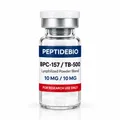
BPC-157 vs TB-500 compares two research peptides that are often named together but have little in common in origin and structure. BPC-157 is a 15 amino acid fragment derived from a protein in gastric juice. TB-500 is a 7 amino acid fragment of thymosin beta-4, a protein found in almost all mammalian cells. This guide explains where each peptide comes from, how they are built, in which preclinical research areas they are studied, what our 10 + 10 mg blend contains, why both are on the WADA Prohibited List, and how they compare in a table.
BPC-157 vs TB-500: two peptides with different origins
The name BPC-157 stands for "body protection compound". In the early 1990s, the research group of Predrag Sikirić in Zagreb described a protein isolated from human gastric juice and named it BPC. BPC-157 is a synthetic partial sequence of that protein, 15 amino acids long, and is therefore called a pentadecapeptide.
TB-500 is based on thymosin beta-4 (Tβ4), a protein of 43 amino acids that was first described in extracts of the thymus gland and later found in nearly every cell type. Its best-known function is binding actin, the protein that forms the internal scaffold of cells. TB-500 reproduces the short segment of Tβ4 that is responsible for this actin binding.
So the first difference in BPC-157 vs TB-500 is the source: one comes from a digestive protein, the other from a cytoskeleton-regulating protein.
Structure and sequence: BPC-157 vs TB-500 at the molecular level
BPC-157 has the sequence Gly-Glu-Pro-Pro-Pro-Gly-Lys-Pro-Ala-Asp-Asp-Ala-Gly-Leu-Val (15 amino acids) and a molecular weight of about 1,419 Da. Its three consecutive proline residues make the chain relatively rigid. Laboratory studies describe it as unusually stable in gastric juice for a peptide of this size.
TB-500 has the sequence Ac-Leu-Lys-Lys-Thr-Glu-Thr-Gln (7 amino acids), residues 17 to 23 of thymosin beta-4, with an acetylated N-terminus. Its molecular weight is about 889 Da. The LKKTETQ motif is the actin-binding site of the full protein.
BPC-157 is therefore about twice as long and has no direct relationship to actin. TB-500 is a short motif peptide whose function is defined by the parent protein. For analytical work this means different HPLC conditions and different masses to check in the certificate of analysis.
Research areas: where BPC-157 and TB-500 are studied
Both peptides appear in tissue repair research, which is why they are often compared. The specific questions differ.
BPC-157 is studied mainly in rodent models of gastrointestinal lesions, which follows from its origin, and in models of tendon, ligament and muscle injury. Other preclinical work looks at blood vessel formation (angiogenesis) and interactions with the nitric oxide system. A review by Seiwerth et al. (Current Pharmaceutical Design, 2018) summarises this preclinical literature.
Thymosin beta-4, the parent protein of TB-500, is studied in cell migration, actin dynamics and wound models. It was studied in a rat wound model by Malinda et al. (Journal of Investigative Dermatology, 1999) and in cardiac cell models by Bock-Marquette et al. (Nature, 2004). An important point: most of this literature uses the full 43 amino acid protein, not the 7 amino acid fragment. Published data on the TB-500 fragment itself are much more limited.
BPC-157 vs TB-500: what the evidence base looks like
For both peptides, the evidence is almost entirely preclinical: cell culture, tissue models and animal studies. A systematic review by Vasireddi et al. (HSS Journal, 2025) on BPC-157 in orthopaedic research found that the available data come mostly from animal models. For TB-500 as a fragment there are no completed clinical trials that would allow statements about humans.
This affects how the comparison should be read. BPC-157 vs TB-500 is not a question of which is "stronger", because no study design supports such a ranking. It is a question of which molecular mechanism a research design wants to examine: a gastric-derived peptide with broad preclinical data, or an actin-binding motif of a well-characterised protein.
BPC-157 vs TB-500 in one vial: the 10 + 10 mg blend
Because both peptides are studied in overlapping research areas, some research designs examine them together. For this purpose we supply the BPC-157 / TB-500 blend: one sealed vial with 10 mg BPC-157 and 10 mg TB-500, a fixed 1:1 ratio by mass and 20 mg peptide in total. The advantage is an identical ratio in every sample and a single reconstitution step. The limitation is that the ratio cannot be changed. Designs that need a different ratio or each compound on its own use the single vials of BPC-157 (5 and 10 mg) and TB-500 (5 and 10 mg).
WADA and regulatory status of BPC-157 vs TB-500
Both peptides are prohibited in sport at all times. The WADA Prohibited List names BPC-157 in class S0 (non-approved substances) and lists thymosin beta-4 and its derivatives, explicitly including TB-500, in class S2 (peptide hormones, growth factors and related substances).
Neither BPC-157 nor TB-500 is an approved medicine in the EU or the US as of October 2026. Both are sold as research chemicals for laboratory use and are not intended for use in humans or animals.
BPC-157 vs TB-500: comparison table
| Property | BPC-157 | TB-500 |
|---|---|---|
| Origin | Partial sequence of a protein from human gastric juice | Fragment (residues 17–23) of thymosin beta-4 |
| Length | 15 amino acids (pentadecapeptide) | 7 amino acids (heptapeptide), N-acetylated |
| Sequence | GEPPPGKPADDAGLV | Ac-LKKTETQ |
| Molecular weight | approx. 1,419 Da | approx. 889 Da |
| Main research areas | Gastrointestinal, tendon, ligament and muscle models, angiogenesis | Actin binding, cell migration, wound and tissue models |
| Evidence base | Mainly preclinical | Mainly preclinical, largely on full-length Tβ4 |
| WADA | Prohibited (S0) | Prohibited (S2) |
| Approved medicine | No | No |
| Vials at peptidebio | 5, 10 mg | 5, 10 mg |
The blend with 10 mg of each compound is listed separately, as described above.
FAQ: BPC-157 vs TB-500
Is TB-500 the same as thymosin beta-4?
No. Thymosin beta-4 is a protein of 43 amino acids. TB-500 is a synthetic 7 amino acid fragment that reproduces its actin-binding segment (residues 17 to 23).
Why are BPC-157 and TB-500 sold as a blend?
Both are studied in overlapping preclinical research areas. A pre-mixed blend gives research designs that examine both compounds the same 1:1 ratio in every sample.
Is the BPC-157 TB-500 blend prohibited by WADA?
Yes. Both components are on the WADA Prohibited List, BPC-157 in class S0 and TB-500 in class S2, so the blend is prohibited as well.
Can I order BPC-157 and TB-500 for research in the EU?
Yes, we ship to research customers in EU countries from our warehouse in the Netherlands, with tracking. Both peptides are supplied as research chemicals only. Neither has a marketing authorisation from the EMA or any national medicines agency.
Sources and further reading on BPC-157 and TB-500
Sikirić P et al. (1993). Original description of BPC from gastric juice. Journal of Physiology (Paris).
Seiwerth S et al. (2018). Review of preclinical BPC 157 research. Current Pharmaceutical Design.
Vasireddi N et al. (2025). Systematic review of BPC-157 in orthopaedic sports medicine. HSS Journal.
Malinda KM et al. (1999). Thymosin beta-4 in a wound model. Journal of Investigative Dermatology.
Bock-Marquette I et al. (2004). Thymosin beta-4 in cardiac cell models. Nature.
Read more: BPC-157 · TB-500 · BPC-157 / TB-500 blend · BPC-157 and TB-500 research peptides · Peptide calculator
For laboratory research only. Not for use in humans or animals. Not a medicine, food supplement, food or cosmetic. This guide summarises published research and is not dosing or medical advice.