
Retatrutide vs tirzepatide vs semaglutide is a comparison of three synthetic peptides that act on the same hormone system but address a different number of receptors: semaglutide activates one receptor (GLP-1), tirzepatide two (GLP-1 and GIP) and retatrutide three (GLP-1, GIP and glucagon). This guide compares their receptor targets, their molecular build, their development and approval status as of October 2026 and the questions the research literature asks about each of them. A comparison table and a section on which compound suits which laboratory question follow.
Retatrutide vs tirzepatide vs semaglutide: one, two or three receptors
All three compounds belong to the incretin field. Incretins are gut hormones that the body releases after a meal. The two best known are GLP-1 (glucagon-like peptide-1) and GIP (glucose-dependent insulinotropic polypeptide). A third hormone, glucagon, comes from the pancreas and belongs to the same receptor family. Each hormone has its own receptor on the cell surface, and an agonist is a molecule that binds to such a receptor and activates it.
Semaglutide is a selective GLP-1 receptor agonist. It addresses a single receptor.
Tirzepatide is a dual agonist at the GIP and GLP-1 receptors. One molecule activates both.
Retatrutide (research code LY3437943) is a triple agonist at the GIP, GLP-1 and glucagon receptors.
The number of receptors is the core difference in any retatrutide vs tirzepatide comparison. It also explains why the three compounds are often studied side by side: together they form a series in which each step adds one receptor. Researchers use that series to ask what the second and the third receptor contribute compared with GLP-1 alone.
Molecular structure of semaglutide, tirzepatide and retatrutide
Native GLP-1 is broken down in the blood within minutes, mainly by the enzyme DPP-4 and by filtration in the kidney. All three compounds were engineered to avoid this, and they use similar building blocks to do it.
Semaglutide has 31 amino acids and is based on the sequence of human GLP-1. The amino acid Aib at position 8 protects it against DPP-4. A C18 fatty diacid chain, attached through a linker, binds the molecule to albumin in the blood. Molecular weight: about 4.1 kDa.
Tirzepatide has 39 amino acids. Its backbone is based on the GIP sequence and was modified so that it also activates the GLP-1 receptor. It contains two Aib residues and a C20 fatty diacid chain. Molecular weight: about 4.8 kDa.
Retatrutide also has 39 amino acids and a GIP-based backbone, with several non-natural amino acids that add glucagon receptor activity. Like tirzepatide it carries a C20 fatty diacid chain. Molecular weight: about 4.7 kDa.
The fatty acid chain is the reason why all three are described as long-acting: binding to albumin extends the half-life from minutes to several days. For laboratory work this lipidation matters too, because it makes the peptides more hydrophobic than native GLP-1, which affects solubility and retention times in HPLC analysis. Semaglutide is the only one of the three that has also been developed as a tablet, combined with the absorption enhancer SNAC.
Development and approval status of retatrutide, tirzepatide and semaglutide in 2026
The three compounds are at very different stages. This difference matters for anyone who reads literature or regulatory documents on them.
Semaglutide was developed by Novo Nordisk. It has been approved as a prescription medicine under brand names since 2017 in the US and since 2018 in the EU.
Tirzepatide was developed by Eli Lilly and has been approved as a prescription medicine under brand names in the US and the EU since 2022.
Retatrutide is also an Eli Lilly compound. As of October 2026 it is in phase 3 clinical trials (the TRIUMPH programme) and is not an approved medicine in the EU or the US.
The approved medicines are finished products with a marketing authorisation, in the EU granted through the European Medicines Agency (EMA). The vials we supply are not those medicines. They are research chemicals for laboratory use and are not intended for use in humans or animals. A list of registered retatrutide trials and their status is available in the public registry at ClinicalTrials.gov.
What the research literature studies on retatrutide, tirzepatide and semaglutide
Each compound has its own body of literature, and the questions differ with the development stage.
Semaglutide has the largest literature of the three. Beyond the large clinical programmes, such as the STEP 1 trial (Wilding et al., New England Journal of Medicine, 2021), it is studied as a reference GLP-1 receptor agonist in receptor pharmacology, in work on albumin binding and in formulation research.
Tirzepatide research focuses on what dual agonism means at the receptor level. Laboratory studies describe it as an imbalanced agonist, with stronger activity at the GIP receptor than at the GLP-1 receptor, and with a signalling bias at the GLP-1 receptor (Willard et al., JCI Insight, 2020). Its clinical programme includes the SURMOUNT-1 trial (Jastreboff et al., New England Journal of Medicine, 2022).
Retatrutide has the youngest literature. Its discovery and preclinical profile were described by Coskun et al. (Cell Metabolism, 2022). It was studied in a phase 2 trial published by Jastreboff et al. (New England Journal of Medicine, 2023). Open research questions concern the role of the glucagon receptor component and how the balance between the three receptors is set.
In short, the retatrutide vs tirzepatide question in the literature is mainly a question about the glucagon receptor, while the tirzepatide vs semaglutide question is mainly about the GIP receptor.
Retatrutide vs tirzepatide vs semaglutide: comparison table
| Property | Semaglutide | Tirzepatide | Retatrutide |
|---|---|---|---|
| Receptor targets | GLP-1 | GLP-1 + GIP | GLP-1 + GIP + glucagon |
| Agonist type | Selective (mono) | Dual | Triple |
| Amino acids | 31 | 39 | 39 |
| Backbone based on | GLP-1 | GIP | GIP |
| Fatty acid chain | C18 diacid | C20 diacid | C20 diacid |
| Molecular weight | approx. 4.1 kDa | approx. 4.8 kDa | approx. 4.7 kDa |
| Developer | Novo Nordisk | Eli Lilly | Eli Lilly (LY3437943) |
| Status October 2026 | Approved medicine (other names) | Approved medicine (other names) | Phase 3, not approved |
| Vials at peptidebio | 2, 5, 10, 15 mg | 5, 10, 15, 30 mg | 5, 10, 15 mg |
Retatrutide, tirzepatide or semaglutide: which compound fits which research question
The choice follows from the receptor question of the experiment. The following overview is meant for laboratory and in vitro research only.
GLP-1 receptor alone: semaglutide is the usual reference compound when a study needs clean GLP-1 receptor activation without a second receptor.
Contribution of the GIP receptor: tirzepatide next to semaglutide shows what changes when GIP receptor activity is added to GLP-1.
Contribution of the glucagon receptor: retatrutide next to tirzepatide isolates the effect of the third receptor, since both share a GIP-based backbone.
Full series: all three together form a mono, dual and triple agonist series for receptor assays, signalling studies or binding experiments.
Analytical work: the three lipidated peptides are useful test substances for HPLC and mass spectrometry methods that need to separate similar, hydrophobic peptides.
If a study only compares two compounds, the receptor difference decides which pair makes sense: retatrutide vs tirzepatide for glucagon, tirzepatide vs semaglutide for GIP.
Retatrutide, tirzepatide and semaglutide vials at peptidebio
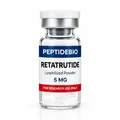
We supply all three compounds as lyophilised powder in sealed glass vials, with the amount and the lot number on the label. Retatrutide is available in 5, 10 and 15 mg, Tirzepatide in 5, 10, 15 and 30 mg and Semaglutide in 2, 5, 10 and 15 mg. For documented batches a certificate of analysis is available on request with the lot number, reporting identity by mass spectrometry and purity by HPLC. The peptide calculator helps to work out concentrations after reconstitution with bacteriostatic water. All three are listed together under GLP-1 and metabolic research peptides.
FAQ: retatrutide vs tirzepatide vs semaglutide
What is the main difference between retatrutide and tirzepatide?
Both have 39 amino acids, a GIP-based backbone and a C20 fatty acid chain. Retatrutide additionally activates the glucagon receptor, which makes it a triple agonist, while tirzepatide is a dual GIP and GLP-1 agonist.
Is research-grade semaglutide the same as the approved medicine?
No. The approved medicines are finished, authorised products. Our vials contain the peptide as a research chemical for laboratory use only. They are not medicines and are not intended for use in humans or animals.
Is retatrutide approved anywhere?
No. As of October 2026 retatrutide is in phase 3 clinical trials and has no marketing authorisation in the EU or the US.
Can I order these peptides for research in the EU?
Yes, we ship to research customers in EU countries from our warehouse in the Netherlands, with tracking. The vials are sold as research chemicals only. Medicines in the EU are authorised through the EMA and the national agencies, and our products are not authorised medicines.
Sources and further reading on retatrutide, tirzepatide and semaglutide
Wilding JPH et al. (2021). STEP 1 trial on semaglutide. New England Journal of Medicine.
Jastreboff AM et al. (2022). SURMOUNT-1 trial on tirzepatide. New England Journal of Medicine.
Jastreboff AM et al. (2023). Phase 2 trial on retatrutide. New England Journal of Medicine.
Coskun T et al. (2022). Discovery and preclinical profile of LY3437943 (retatrutide). Cell Metabolism.
Willard FS et al. (2020). Receptor pharmacology of tirzepatide. JCI Insight.
Read more: Retatrutide · Tirzepatide · Semaglutide · GLP-1 and metabolic peptides · Peptide calculator
For laboratory research only. Not for use in humans or animals. Not a medicine, food supplement, food or cosmetic. This guide summarises published research and is not dosing or medical advice.